Why Did Harry Findlay Called Denman The Tank?

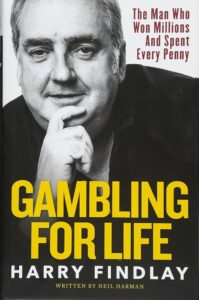
Harry Findaly: Gambling For Life.

That’s the name of his book written by Neil Harman, published by Sport Media in 2017.

Findlay is by his own admission a Marmite kind of person: you either love him or ‘hate him. To be fair, I’ve warmed to him as I plough through his book about ‘The Man Who Won Millions And Spent Every Penny’.

I guess there are professional gambler books about poker which talks about giant bet but for a gambler in the United Kingdom I doubt there have been many who would fill his boots. Fearless isn’t the word, bordering on insanity some might say. I can’t imagine how he coped with all the stress. One moment springs to mind when he lost £100,000 in one day betting on five odds on shot at Hexham – all beaten. Another occasion, selling his house to Tony Bloom for £100,000 and tied himself up in so many knots betting on a cricket match that all he could hope was to get his money back. The book is full of so many crazy stories he must have felt as if he was on a roller coaster ride he couldn’t get off.

However, there have been many good days. One being the purchase of Denman for his mother with Paul Barber. One of the best investments of his life, an equal share of £60,000, in a beast of a horse, who took the National Hunt by storm.

Denman was a horse going places, even in those early days when winning at Wincaton, beating Victor Darnall’s Karanja by 16 lengths. The jockey on the runner-up, Andrew Thornton said: ‘That’s a f****** monster.’

Harry was convinced Denman was a future Cheltenham Gold Cup winner and was betting on him whenever the opportunity came.

On the 10th February 2006, Bangor-on-Dee, Denman was meant to face Black Jack Ketchum but he was withdrawn when an overnight frost brought concerns. Denman faced little opposition and priced 1/12f. Harry Findlay bet £360,000 to win £33,000. He said: ‘It was the easiest money I ever won!’

His first Chase experience saw him head to Exeter where he faced a worthy challenger in Penzance who ‘sailed the fence’ while Denman missed a stride and ploughed through four foot of birch. What surprised Findaly wasn’t that he landed on his feet but that he didn’t lose any ground on his opponent.

Harry put down his binoculars and said: ‘F*** me, he’s a tank.’

From that moment he was The Tank.

Denman went on to fulfil his ambitions winning the Chelteham Gold Cup in 2008.

How do I find Value in a Small Field?

When gambling, it is important to have a little bit of introspection. Consider how you work because this is founded by how you think. It is all too easy to do something without giving it due consideration. I’ve found that punters all too often follow scripts. It’s literally like a script is playing in their mind and they just follow it like an actor saying their lines. This is all good and well if the script, actions, betting is productive and returns a profit. However, if your name is Jack Torrance, staring out the window of the Overlook Hotel, and your notepad says: ‘All work and no play makes Jack a dull boy!’ you may need to stop for a moment and reflect.

Now, I don’t know of too many punters who have put an axe through a door (although plenty may have felt like it) but be advised to stop and reflect on your thoughts with reflexivity and ask: ‘What’s going on here?’

Because, my friend, it may be something you don’t want or expect.

One of the best ways of doing this is to keep a journal and simply put pen to paper your thoughts, processes and conclusions. This is actually much more difficult than it seems but becomes easier with practice. The act of writing down your thoughts is proven to be much more powerful than thinking alone.

I have noticed how many times punters follow that same well-trodden path.

You follow that horse off a cliff! You follow that trainer who hasn’t had a winner in a month of Sundays!

You even woke up to find you had an axe in your hand!

It’s part of the human condition. The brain works in mysterious ways in an effort to make our lives simple. At times this literally leads you down the garden path wearing your comfy slippers and a hair shirt.

I’ve had this blind spot with horse races featuring a small field of let’s say 5 or less runners. This is in the two-year-old niche, as I know little about anything else. Often I would see the favourite priced at prohibitive odds. For example it is 1/4f. Now, there is a tendency to start following that destructive script, deep in your grey matter. I can tell you what it is saying: ‘The favourite is going to win so don’t bother thinking about this race and move swiftly on.’

Stop for a moment and write in your journal: ‘F*** the script!’

Because this is a problem and until you have to change it.

You don’t need it.

Here’s my reasoning. If you don’t bet odds on (I don’t) you will never bet on the jolly (favourite) in a million years. So all that horse can do is prevent you from betting. It’s like a big, old, bastard of a brick wall. It’s all pointless. It is a negative because it can only lead to another negative. When gambling, you have the opportunity to bet in the positive which gives you opportunities. You can structure your approach to work in the positive and that is a foundational skill to your thinking.

If you don’t bet in a race because you are scared of the odds on favourite that race is null and void.

However, think for a moment. Have you even looked at the race? You didn’t because you jumped to the conclusion the favourite had already won the race. Well, Jack Torrance, the race hasn’t even started yet!

You remember the positive script: ‘There’s no such thing as a certainty?’

Look at the three horses in opposition to the favourite. What do you think? There’s a 100/1 outsider who realistically is no opposition. The second favourite is unraced and given a fighting chance based on morning gallops and hyperbole. The third favourite has one race under its belt and presently priced 15/1 on Betfair.

There is a chance to nothing going on here.

Why? Because the chances are the second favourite (unraced) will not live up to expectation. It is much more difficult for a debutante to win than the betting always suggests. It’s a statistical fact. The outsider has no hope. Within moments, you realise there is a very good chance this is a two-horse race. The odds on shot is priced 1/3. The horse you have your eye on is 14/1. Now no one is saying that every odds on favourite is going to lose. If you think I’m saying that you are following a negative script.

Remember if you don’t bet on odds on shots but fear the horse is the winner you stopped looking, thinking and considering. You gave the race the briefest glance. That’s your script at work.

By betting on the value in a small field you have a number of options to make money when betting on the exchanges:

  • The horse may be substantially backed giving an easy no-lose bet.

  • The betting in-running is very volatile and there is a very good chance your horse will touch must shorter odds.

  • Unlike the favourite which needs a 75% (if 1/3f) your horses needs to win once in fourteen times to break even.

By all accounts, the majority of times, it is simply a two-horse race. You have many and varied opportunities to make money here.

Each race needs to be viewed on its merits. Sometimes you win, sometimes you lose. It’s the nature of the beast.

However, stop for a moment and think about those scripts running through your mind. An equal measure of help and hindrance. You have the opportunity to pick between the two. The choice is yours.

The moral of this article isn’t about betting on a 14/1 winner.

It about the next time you look at the race card and you quickly skip the small race with the 1/4f that you have just fallen into a hole that only a psychologist could have dug. He’s peering down at you and saying: ‘It’s OK, Jack. Put the axe down and we can talk things through…’

When Is Two-Year-Old Horse Most Likely To Win A Race?

At first glance this may seem a strange question. However, if you have any understanding of two-year-old horse racing it should capture your attention. You may say why? Well, if you want to make your betting pay these kind of questions needs answers. Perhaps you think horses simply win in a random nature. In some respects they do. However, there is good reason to appreciate why a horse may when in any given race. If you are interested in a horse winning let’s say a maiden race on its 1st, 2nd, 3rd, 4th or 5th race it is a positive to have some understanding and how and why this may happen.
Considering two-year-old horses start as a blank slate when it comes to form they are a different kettle of fish to older horses (clearly, older horses may be making their debut too but in general they are different to the juveniles).

The chance of a two-year-old winning is very much to do with the horse owner, trainer, breeding, betting and other factors and variables. One thing you can guarantee is that if a horse doesn’t have the intention of winning on debut (or any time for that matter) it is very unlikely they will win. It’s not impossible as trainers do say they were surprised their horse won but compared to those who think their horse has a live chance the numbers are small.

Two-year-old horses by their nature are inexperienced and due to their date of birth mature at different rates. This has a biological underpinning too.

However, if you had to consider the most likely time a two-year-old horse is going to win what would you say?

Many of you would say a decent juvenile should win on debut. And to a point that is true. Logically a horse that has a level of ability should be able to win on its racecourse bow. However, it may well be opposing horses with experience and this makes life a little harder. Inexperience can prove costly for debutantes and reason why it can be a difficult time for them to win. I would suggest it has as much to do with the opponents in the race as the ability of the debutante itself. If a horse starts slowly it can be very difficult for them to make up ground especially over a sprint distance. Also, a trainer may well instruct the jockey to give the horse a nice introduction. They don’t want to frighten the horse or put it off racing which can happen more easily than you think. For these reasons first time out is a fair opportunity for a horse to win but not the most likely day.

In my opinion, the best time for a two-year-old horse to win is second start. From my statistical work it is a fact. Clearly, again, this does vary from horse trainer to trainer. However, with the initial experience on debut a horse is generally fitter, wiser and placed to give a good account of itself. Also, the intention is to win. The jockey will be told to make every effort to win and if its a close finish they will be determined to the line. If you are betting blind, with no interest in form or betting price (which is unwise) you would have some hope of finding a winner on the horse’s second start compared with others.

Remember we are talking about horses winning maiden race or more precisely non handicaps. For many two-year-olds of limited ability their best option is to race in a nursery. This is where horses are allotted a weight for their perceived ability and they run in that category. For example, a horse may be given an official rating of 60. It is allowed to run in a race 0 – 60 (if can run in a higher grade race). This restricts the competition as a horse rated over 60 wouldn’t be illegible to race in this class. Basically, this gives lesser class horses a chance to win. No owner would be interested in owning a horse if it was impossible to win.

So we have to consider that a lesser class horse is unlikely to win a maiden in its first few starts as the competition is stiff. In addition, it must race at least three times in a maiden for the official handicapper to observe the horse and be able to give it a handicap mark. Sometimes the horse will have to run four times.

Most two-year-old horses will be run on their merit. The more cynical race fan would suggest many juveniles are not trying so they are given a low handicap mark.

Two-year-olds running on their third and fourth start are less likely to win than first and second start. This is mainly detailed in the fact they couldn’t win on those earlier starts. So in ways, the more races a horse takes to win a maiden race the less chance they have of winning. If a horse has been in a few competitive races it may have been unlucky and take advantage when it finds a weaker race. For this reason, horses which are priced at shorter odds have an increased chance of winning compared to those at bigger odds. Yes, I know that sound stupidly logical but there is slightly more to that last comment than meets the eyes.

Most horses which haven’t won a maiden on their first four starts will be heading to nursery races to take advantage of a lower category of racing.

To appreciate the chance of any horse winning it needs to be assessed as an individual and on its merits. It wouldn’t make sense to generally view a two-year-old on its second start as the reason to bet disregarding other factors. However, it would be a mistake no to appreciate that if a horse is likely to win in its career its second start is of interest.

Which horses would you recommed for the 2024 Spring Double?

Although rarely spoken or written about as such, the ‘Spring Double’ remains a time-honoured and potentially lucrative ante-post bet, which involves coupling the winner of the Lincoln Handicap at Doncaster with the winner of the Grand National at Aintree. Traditionally the feature race on the opening day of the British Flat season, on turf at least, the Lincoln Handicap is scheduled for Saturday, March 23, 2024, while the Grand National is due to take place three weeks later on Saturday, April 13, 2024.

At the time of writing, the first leg of the Spring Double, the Lincoln Handicap, is still some months away, but the ante-post markets for both races are taking shape. Indeed, in the unlikely event that the ante-post favourite, or joint-favourite, wins both legs, the current odds of reward are a not-to-be -sneezed-at 128/1, so it’s definitely worth taking a look at the likely contenders, even at the early stage.

The 97-rated 4-year-old Botanical, trained by Roger Varian, currently heads the ante-post market for the Lincoln at odds of 8/1. The Lope De Vega has won two of his five starts so far, both at distances beyond a mile, on good to soft and soft going, on the undulating, testing track at Hamilton. Indeed, on his most recent visit to the South Lanarkshire course, in October 2023, Botanical ran out an easy 6-length winner of a Class 3 handicap, for which he was subsequently raised 10lb in the weights. At that stage, Varian said, ‘…he should be a nice horse next year’, although he did add, ‘…ground is quite important to him’.

Notwithstanding the cancellation of 2020 renewal, due to the Covid-19 pandemic, the word ‘soft’ has failed to appear in the going description on Town Moor just three times in the last ten runnings of the Lincoln. Botanical may well have his ideal underfoot conditions, but the 10lb rise obviously makes life more difficult in a race as competitive as this and whether he’s quite as effective over the mainly flat, straight mile at Doncaster remains to be seen.

Obviously, with 97 entries for the Lincoln at this early stage, there are plenty of alternatives. For a recommendation, though, we’re looking to the lightly-raced 6-year-old Chazzesmee, trained by James ‘Fozzy’ Stack in Co. Tipperary. The son of high-class miler Excelebration was an comfortable winner at Naas in March 2023 and, despite a 98-day break, came within a length of defying a 13lb rise in the weights in a valuable handicap at the Curragh the following July. That form makes good reading in the context of this race and, with underfoot conditions unlikely to pose a problem, Chazzesmee makes no little appeal at 16/1.

Notwithstanding the reduction in the number of starters, from 40 to 34, in 2024, the Grand National still presents the thorniest of thorny problems from a punting perspective. Bookmakers currently bet 16/1 the field, which brings in last year’s winner Corach Rambler, trained by Lucinda Russell, Mahler Mission, trained by John McConnell in Co. Meath, and Vanillier, trained by Gavin Cromwell, also in the so-called ‘Royal County’.

Of that trio, despite lacking experience of the idiosyncratic Aintree fences, the second-named makes the most appeal, having finished a gallant, 3¾-length third in the Coral Gold Cup at Newbury on his reappearance, despite losing both front shoes in the process. Mahler Mission was arguably an unlucky loser when falling at the second-last fence, when still 4 lengths in front, in the National Hunt Challenge Cup at the Cheltenham Festival last March. His stamina for the extra half a mile or so of the Grand National needs to be taken on trust, but he was keeping on well at the time of his Festival mishap, so looks to have bright prospects.