

Do You Know Brian Lee?

That’s what my brother asked.

I find it disheartening that I’ve never heard about Brian, given his extensive 50-year career as a horse racing journalist—especially considering my own passion for horse racing spanning over 30 years. With a focus on two-year-old horse racing and a fondness for Chepstow Racecourse, he likely shared valuable insights on numerous talented juveniles.

Recently, my brother shared a link to an article about Brian published on the Chepstow Racecourse website by Graham Thomas. In this piece, the proud Welshman delved into his deep interest in horse racing and reflected on his career in racing journalism. Brian’s contributions extended to various Pembrokeshire newspapers, including the now-defunct Barry Gem.

The 86-year-old continued (and continues) his writing journey with a column in the Western Mail, covering horse racing for an impressive fifty years. Despite the challenges faced by the newspaper industry, leading to the discontinuation of his column, Brian remains dedicated to his love of writing. Far from retired, this highly respected horse racing writer and author of numerous books on the sport is a familiar face at Chepstow Racecourse. In 2020, he received the prestigious Lifetime Achievement honor at the ROA Welsh Horse Racing Awards.

Brian fondly recounted his initiation into horse racing at the 1949 Welsh Grand National, with his true passion ignited at a transformative point-to-point meeting at Rhiwbina Farm. His journey in racing journalism began at the age of 15 when he voiced concerns to Horse and Hound magazine about the lack of local sports coverage—resulting in a job offer.

From contributing to The Sporting Life to writing under ghost names for publications like the South Wales Argus and The Hereford Times, Brian’s influence on racing journalism is vast. His collection of scrapbooks, cuttings, and notes spans generations of horses, trainers, and jockeys, many of whom started in point-to-point racing before transitioning to formal competitions.

Brian’s experiences include encounters with notable figures like trainers Evan Williams and Peter Bowen and Aintree Grand National-winning jockeys Hywel Davies and Carl Llewellyn. Recalling the vibrant atmosphere at Penllyn racecourse, he marvels at the bustling scene with 34 bookmakers— a stark contrast to today’s racing that often has just six.

Despite witnessing unforgettable moments like Prince Monolulu at Cheltenham, Brian’s heart still longs for a Welsh trainer to win the Welsh Grand National, a feat not achieved since 1905. Summing up his journey, he describes it as a “labour of love.”

In the realm of horse racing journalism, it’s truly a pleasure to read and write about a gentleman like Brian—a seasoned expert who, after fifty years, continues to exude passion and knowledge about the sport.
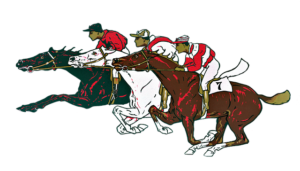
Who were the connections of the record-equalling two-year-old Provideo?

Readers of a certain age will surely remember the prolific two-year-old Provideo who, in 1984, won 16 of his 23 starts and, in so doing, equalled the British juvenile record set by The Bard, against retricted, modest opposition, in 1885. A January foal by Godswalk, the winner of the King’s Stand Stakes in 1977, Provideo opened his account, at the first attempt, in the Brocklesby Stakes – traditionally the first two-year-old race of the season – over five furlongs at Doncaster in March, 1984. He won comfortably, by four lengths, on that occasion and again, by seven lengths, at Catterick the following week.

However, at Catterick he had reportedly looked ‘a little less than straightfoward’ and, following two subsequent defeats, at Lingfield and Thirsk, he was fitted with blinkers, which proved to be the making of him. Eight months or so, and another 13 wins – which included the Ripon Champion Two-Year-Old Trophy in August – later, on November 1, 1984, Provideo was sent off 1/8 favourite to beat five modest rivals in the Dinsdale Spa Stakes at Redcar. He duly obliged, winning as easily as his odds suggested he might, by seven lengths, to equal the record.

A habitual front-runner, Provideo evidently impressed the learned scribes at Timeform, who named him ‘Horse of the Year’ despite his annual rating being only a ‘smart’ 112, compared with ‘top class’ 136 achieved El Gran Senor, whose only defeat of the season came when controversially beaten, by a short head, in the Derby. Anyway, to answer the question, Provideo was bred and owned by Ahmed Foustok, a wealthy British-based Saudi Arabian, in whose red-and-green checked colours he ran, trained by William ‘Bill’ O’Gorman, at Seven Springs, on the Hamilton Road in Newmarket, and ridden in all bar one of his races by stable jockey Tony Ives. Ives, who eventually rode 1,064 winners, described him as ‘the toughest horse I ever rode’.

Who is Western Art?

I once messaged a horse breeder called Nellie Cox who said: ‘There’s a story behind every horse.’

This lead from a story about an ex-racehorse called Western Art.

Many years ago, my brother, a plasterer at the time, did some work for a family who looked after an ex-racehorse called Western Art. The horses was owned by a lovely lady who had re-homed Artie for his new life.

Touched by the story, I wrote a post on one of my websites. Some months later, the lady contacted me saying: ‘That’s my horse!’

Listening to the story of Artie in his new life filled my heart with joy. After being a very successful two-year-old race colt he had suffered injuries, which saw his form declined, and by the age of four he had been retired from training. This was all the more distressing because as a two-year-old he had won a Listed race as Sandown Park collecting a prize of £12,207. The lady knew little to nothing about his past. So I decided to investigate and research Artie’s story to fill in the gaps.

As with so many horses it was a remarkable story.

He was born at Rose Retreat Farm, Goochland, Virginia, USA, by a breeder named Nellie Mae Cox and sold at the Keeneland September Yearling Sales for $40,000.

He was later sold as two-year-old for £62,000.

Artie’s owner was able to contact Nellie Cox who remembered him as a foal and his pet name. It was thrilling to hear his story before the racing years.

Western Art, as he was named by his owner, Matthew Green & Ben Sangster was purchased by bloodstock agent Peter Doyle and trained by Peter Chapple-Hyam at St Gatien, All Saints Road, Newmarket.

I sent a message to Mr. Doyle asking if he had any details about this horse. I didn’t think too much more about it, half considering he wouldn’t have the time or interest in giving me the background story.

In fact, I forgot all about a reply until my mother said someone was on the phone and wanted to speak to me.

It was Peter Doyle. A softly spoken Irish man asked how he could help and looked back at the information he kept for each and every horse. It was a wonderful conversation and he asked as many questions about myself, Artie and his owner as I did of him. Later in the chat, he said he was getting ready for Royal Ascot and in July would be heading to Newmarket. He invited us to go to the races and have a chat with him.

I regret not taking up his offer because it would have added to the story which now encompassed not only Western Art ‘Artie’ but his breeder, bloodstock agent, owners and trainers.

Researching a horse was a journey which touched my heart because Artie was loved by many people in his life.

But his greatest love was a lady named Alex Smith.

As Nellie Cox said: ‘There’s a story behind every horse.’

There was never a truer word said.

God bless, Artie.

In memory of Nellie Cox who passed away on the 24th February 2015.

Is betting on Debutantes a good idea in racing?

Betting two-year-old race horses can be a tricky business. It’s reason why most punters fear betting on juveniles. In fact, the majority of punters steer clear.

There is one major reason why punters feel betting on debutantes is a bad idea. It’s simply because they don’t understand the subject matter. That’s the reality of the situation.

They say: ‘You’d have to be mad to bet a two-year-old debutante.’

Those comments are based on limitation. It’s hardly surprising. If you don’t put the work into something you read from a blank slate. Each to their own. However, there is an answer to every question. In truth, most things can be understood at a very simple level. That doesn’t mean it is a simple endeavour to get to that point. But if you know enough about any subject you can progress with an approach that is standardised, replicable and measured.

Success or failure can be measured in profit or loss.

Betting on two-year-old debutantes isn’t easy. And, to be fair, unless you know the score you are best to leave well alone. First, put in the work and learn the subject.

Without question, a horse has more chance of winning on its second start compared to its racecourse bow. It’s a statistical fact. True, a few trainers feature a higher strike rate and some do indeed achieve their best results on debut. However, if you are considering a global perspective it pays to consider betting on a horse on its second start is a much wiser decision.

Here are a few problems when betting on debutantes:

  • Inexperience can lead to a slow start

  • Debutantes often struggle with turning courses

  • Trainers rarely want a horse to be given a hard race to wi

  • Even the best horses get beaten on debut

  • They are often under priced and no value

It is important to appreciate some trainers may run well on debut while others are poor. Also, many horse trainers don’t win at big prices. In fact, many win at short odds only. This is another reason why you need to assess the strength and weakness of each trainer in how they perform.

Horse trainers are creatures of habit.

Betting on debutantes isn’t for the faint-hearted. If you have hopes of making your betting pay then you need to understanding betting on debutantes is difference to any other.

Put in the work and it will pay dividends.