Did Harry Findlay Tempt Fate?

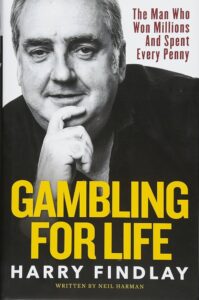
I’ve been reading Harry Findlay’s: Gambling For life, published in 2017 by Sport Media. The book has been well received and told a story so fantastic that you may have thought it was pure fiction.

Findlay has always been a larger than life character, a big man with a big voice and even bigger betting bank until that fateful bet.

I guess each punter has their own way of doing things. And most have their own levels of superstition. You hear of a punter wearing his favourite socks to bring a little bit of luck. Jack Berry, a very successful horse trainer back in the day, always wore a red shirt. I’m not sure if that was down to luck or a fashion statement. Personally, I am one of those gamblers who doesn’t like to say: ‘This will win’ or what can be a real temptation of fate ‘This horse can’t win!’. If you’ve ever given good reason for a 50/1 shot to beat you in a photo finish, that’s it.

If you don’t have any element of the heebie-jeebies and there’s no better evening spent than seeing what the Ouija board spells out for days ahead you may have nothing to fear.

Reading Gambling For Life – The Man Who Won Millions And Spent Every Penny is a great read and well written by Neil Harman.

I can’t help thinking Harry tempted fate with his colossal bet on the All Black to win the 2007 Rugby World Cup.

To make the bet of all bets, above and beyond what is your normal fix, is halfway to tempting fate. And betting £2.5 million is probably the equivalent of tapping the opposite of Lady Luck on the shoulder (we will call her Deborah Doom) and showing her your betting slip and saying: ‘You will be paying this out, Dear!’

Instead of pulling the cash out of her pockets [cheque, as no one has that big pockets] she bends you over and pulls down your pants.

‘Who hasn’t had their pants pulled down!’

Findlay was convinced the bet was a winner, but a quarter-final against France rather than the predicted Argentina wasn’t part of the plan. It was a thorn in his side. He had booked a corporate box at the Millennium Stadium, Cardif, and invited friends and fellow punters who had put their faith in Harry Findlay and ultimately Dan Carter the All Black’s fly-half. With him onside, surely it was a done deal.

How could they lose?

I’m sure Deborah Doom was peeping through a crack in the door and laughing her arse off because she knew the score and it wasn’t going to end well. She’s the type of common bird who dances around the grave of any big-time gamblers who have lost their shirt.

Findlay told everyone he had ever met that New Zealand were ‘certainties’ to win the World Cup 2007. Lots of friends and followers put their money down including gardener Charlie who turned up one day with an ice cream container filled with £28,000. Others who turned up to watch the live match were Paul Barber, co-owner of Denman, Paul Nicholls, the horse’s trainer and friends Jim O’Rourke, Glen Gill and Alex Williamson and a few other mates from across the country.

This was just the quarter finals but a £2.5 million bet at odds of 1.78 [just under 4/5] would potentially return a bumper payday of almost £1.9 million on winning the final.

As each of the guests turned up they were given a goodie bag as a keepsake of the day including a clock in the shape of a rugby ball.

I can only imagine the look on the face of Deborah Doom or what the Ouija board would have spelled out. It would have included more bleeps than Harry could have fit in one sentences. She must have been laughing like a hyena.

If ever there had been a bet that tempted fate more I don’t know what it was.

Things started well (it was just part of Deborah’s Plan) and at half time New Zealand were winning 13 – 3. Harry checked the prices on Betfair and the All Blacks were priced 1.03 to win the match. Perhaps he sensed a moment of foreboding and laid off £600,000 which would have cost a measly £18,000 if they won (which obviously he was praying). As it happened, he must have regretted not laying the whole bloody bet.

Things really started to fall apart when Carter limped off the field midway through the second half.

The feeling in the corporate box become even more solemn when France were given a try that was clearly a forward pass. The try stood. Just 10 minutes to go and Jean-Baptiste Elissalde kicked the conversion which sealed their fate.

France 20 – New Zealand 18.

The All Blacks couldn’t fight back.

Many in the room were left in tears trying to make sense of what happened. The cost on emotion and finances incredible.

Harry Findlay said the train journey home was one of the worst moments of his life, traveling with a crowd of cheering French supporters.

[Deborah would have been screaming: ‘Magnifique!!!!!’]

Alex Williamson, one of the those still hurting in the box recalled Paul Nicholls suddenly reappearing, looking for the freebie clock he’d left on the table in the middle of the room.

He said: ‘I just remember thinking given all that was going on, how funny it was.’

I can tell you this for nothing. There’s another house with a rugby ball shaped clock sitting with pride of place on the mantelpiece. A house decorated with flock wallpaper, a bookshelf filled with professional gambler books, an old record player sits in the corner and on it turning slowly Kenny Roger’s song The Gambler blasts out.

It’s the home of Deborah Doom.

She knew the score.

It never pays to tempt fate.

She will pull your pants down and slap your arse.

What’s The Best Way to Lay Horses to Lose?

With the introduction of betting exchange, punters had the chance to become bookmakers.
At the time of the Betfair going live in 2000, many bookmakers feared the exchange would have an impact on their business. This formation of unregulated ‘bookmakers’ consisted of anyone with a laptop and the knowledge, skill, bravery or ill-thought-out hope they could win a few quid from the stampede of punters using this new platform.

Simply do what the bookmakers do from the comfort of your own home.

Easy. ‘Money without work!’

It’s worth noting that your successful to win at any form of sports betting is skill based.

Sure, you could chance your wad of cash with cold, hard luck, but it wouldn’t last too long in this competitive world.

A few years back, I started laying horses to lose. Being a careful gambler, this dipping my toe into the pool was, to some extent, an unnerving experience.

To be a successful gambler you need to have a plan based on skill and the process to make it work. At a very basic level this is about finding and having answers to questions. If not, what is your basis for understanding? You don’t want to be laying horses to lose based on a wing and a prayer. It’s not good news.

With my experience of two-year-old horse racing and data analysis I was confident I could find an angle that would pay dividends. In my opinion, to outwit the gambling public you need to know more than them (which isn’t an easy thing) as even that strange bloke at the bookmakers may be willing to take your bet. If you make a mistake you will pay the price because there is always someone who knows more. To be fair, there will be times when someone knows more. Your approach needs to detail such a profit that you can afford the odd horse to win. You don’t want it to happen but there is no such thing as perfection in the gambling world.

I decided to lay two-year-old debutantes. There were reasons for this although I don’t want to say too much for obvious reasons. However, the point I am making is you need to know your subject matter as if you are a Mastermind contestant. I’m not joking! You need to have an understanding of your niche subject matter that goes beyond 99% of the population. You may get away with less but you need to draw the line as high as possible.

You don’t need to know everything about everything. There isn’t the time or the need. Just know your subject well.

Believe it or not, I laid over 100 consecutive losers. I can’t quite remember the tally before that first winner popped up and it may have been closer to 150. Luckily it was a 10/1 shot. Considering I was laying horses to win £20 a time that cost me £200. As I was already in profit by over £2,000+ it wasn’t a concern. That’s not to say laying horses at giant odds is a pleasurable experience. Many of the horses I laid to lose were astronomical odds. Some were 100/1+. So a potential loss of £2,000 to win £20.

I know what you are saying: ‘You must be mad!’

I had a few horses at big odds go close. Perhaps a couple of lengths away or finishing well. It’s not what you need. I hoped most lay bets would fall out of the stalls and be instantly outpaced. An easy £20. Some races I would lay four horses. An easy £80. There was never anything easy about laying a horse that was 50/1+. In theory, they were the least likely to win. That suited me fine. However, anything is possible. We’ve all seen the 100/1 shot win (that may be 250/1 on the exchanges). Little by little, although winning £5,000, I wasn’t feeling so comfortable about laying horses at giant odds. In fact, I think just before I stopped laying horses I had a phobia about it. I had always been a person who bet on horses to win and it felt much more natural than all this ‘laying’ horses to lose.

It plays on your morality.

If you laid a horse to lose at odds of 200/1 to win £20 or lose £4,000 (in a National Hunt race with one fence to jump) would you pray the horse fell at the last?

I laid horses to lose on the Flat and within reason I’d be hoping almost anything if it meant I won rather than lost a bundle of cash. If some old witch who lived around the corner gave me a spell I’d have cast it on every horse to lose.

The phobia was setting in.

I felt uneasy with every race and lay bet, especially those at giant odds.

I seemed to hit a plateau. Stuck at £5,000. I’d win a good few hundred and then another 10/1 shot would take the edge off it.

Then one day, after going to my aunts funeral, I noticed a horse to lay in an evening race at Kempton. I thought that would be an easy £20 in my pocket. You don’t need me to tell you the ending of the story but I will.

I laid a debutante trained by Luca Cumani to lose £750. I was pretty convinced it would lose and I would be £20 richer. It didn’t help when the short priced favourite looked in trouble a long way out. I had a distinctly uneasy feeling in the pit of my stomach. Next I scanned to see where the Cumani beast was positioned and how it was going. It was mid-division and going very easily. If I could have bought a ‘killer’ spell for £200 trust me I would have. I had to watch every second as the horse started to fly down the home straight. It was going so fast I knew unless something unbelievable happened (like Mystic Meg burst into the room) that I was witnessing a ‘certainty’. I know they say in racing there isn’t any such thing as a certainty, but this was it. It got to the lead and won by a number of lengths. I was left with the question: ‘Why did I lay that horse on this day?

That’s life.

If you can’t cope with losing then you shouldn’t bet. Not that it makes losing money any easier but it’s the kind of thing Aristotle (the philosopher) would whisper in your ear.

It could have been worse. It could have been a bet that cost me all my winnings.

After that day, I never laid a horse to lose again.

Perhaps I should have carried on. I may have won a fortune. I stopped with £4,000+ in my pocket.

It was a learning experience and not all bad.

Who is Anna Sewell?

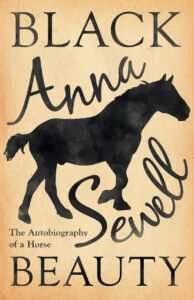
As a child I loved Black Beauty.

Perhaps, just as much, I loved the classic theme music of Black Beauty (galloping home) by Denis King. This was a continuation of the original TV program aired from 1972 – 1974. How I enjoyed the New Adventures of Black Beauty some twenty years after the original series.

Many years later, I realised Anna Sewell was born at Great Yarmouth.

I’ve visited this small Tudor-style house on Church Plain, just a stone’s throw from St Nicholas’ Minster. The house has previously been a restaurant, shop, Christian charity offering free meals and a place of safety, tearoom and lately in the guardianship of Redwings Horse Sanctuary which is the largest horse welfare charity in the UK. In fact, they have cared for more than 1,500 horses, ponies, donkeys and mules.

The house was purchased by a fan of Black Beauty and Redwings after fears it was going to be purchased, dismantled and rebuilt in the USA.

This is the birthplace of Anna Sewell.

Personally, my association with Great Yarmouth is through my Dad’s love of horse racing. And it should come as no surprise that Anna Sewell was a pioneer when it came to highlighting animal welfare.

The daughter of a Quaker family, she was born in 1820. Her father was a successful and prominent banker and her mother a writer who had a number of children’s books published. The family moved to London when she was 14. She was seriously injured when falling and suffered ankle injuries which meant she needed crutches for the rest of her life. The family used a horse and carriage for transport and from this she grew empathetic to the suffering of animals which inspired her only novel in her late 50s titled Black Beauty: His Grooms & Companions.

Published in 1877, she sadly passed away just a few months later although saw her beloved book a success.

Black Beauty is written in the first person and a narrative from the perspective of the horse detailing the mistreatment and care of horses in the 19th century. It was Sewell’s intention to raise awareness of animal welfare, suffering and promote kindness to animals.

The novel quickly gained popularity. Although written for adult horse owners it become a classic title for children’s literature and had a significant impact on the treatment of horses.

Just five months after publication, Anna Sewell passed away on the 25th April 1878. She was aged 58. She is buried in a Quaker cemetery at Lammas, near Buxton.

Black Beauty has never been out of print and sold over 50 million copies and inspired many TV and stage productions.

Her legacy is advocating the humane treatment of animals.

Anna Sewell House is open every Wednesday and Friday at 10am – 2pm (entry is free).

Is It Worth Following a Horse Racing Tipping Service?

Horse racing tipsters.

What comes to mind?

In general, a scammy or unsavoury characters who lives on the seedy side of the street. The classic stereotypical view of someone who sells horse racing tips for a living.

Comment: ‘Those tipsters would say and do anything to get their hands on your money.’

But what is the truth?

I’ve been in the horse racing industry for over 30-years and seen and met a lot of gamblers, race fan and tipsters.

What I’m saying is that horse racing tipsters around the world are your average person who follows horse racing with a passion. They sell tips for an income because they have achieved a level of success. Most have won competitions and proven their ability with a third party that affords objective testing and real profits.

I remember Equine Investments established in 2003. They made their name by winning tipping competitions via Online Betting Guide (OLBG). There are many companies or individuals who have made a living from their work.

What you have to remember, the best in the business are exceptional at what they do and for that reason their services are generally costly. However, you can find tipsters which charge a few pound a month to those which cost £1,000 per year. Individuals who work as consultants may charge several thousand pounds a year. You get what you pay for. However, even the best have their barren periods and that’s why there is no such thing as a guarantee to winning money.

So what are the pros and cons of working with a horse racing tipster?

Pros:

  • A better success rate.

  • Steady supply of information.

  • Proven record which has detailed a points profit

  • Less work than doing it yourself


Cons

  • You are one of many punters receiving the tips which impacts on the betting odds

  • Often tips are detailed well in advance of the race and changing conditions can have a negative impact on success rate

  • There are no guarantees of a profit even if previous years have been successful

  • If you are a regular winner you may find your bookmaker restricts or closes your account

In conclusion:

The vast majority of horse racing tipsters are honest and work very hard to give you a profit. Literally, their success and income depends on it. It’s true the industry has fallen prey to a small number of scam artists which makes people wary. However, many tipsters have a proven track record and winnings.