
 With online gambling taking preference for many gamblers, the sight of brick-and-mortar bookmakers is becoming less common compared to the heyday of the 1960s when off course gambling was legalised. In fact by the 1970s there were over 15,000 bookmakers in the UK. In recent years, the number of bookmakers has fallen and independent shops have diminished due too buyouts and closures.
In the 1980s we had an independent bookmakers at the top of our road. It was owned by one of the Scotney brothers. A small prefabricated building. I can’t say I ever went inside as I was underage. And by the time I reached eighteen (and the legal age to bet) it has gone by the way. There was no televised racing, just a tannoy which blasted out race commentary and results. Dad used to place a few bets each week. His favourite bet an each-way Yankee. With Dad’s betting slip in hand, we’d eagerly await the results on the radio and tell him the news.
He had a number of big wins.
He wasn’t a favourites man.
In this day of bookmaker restrictions and the Gambling Commission White paper to be announced at any time, it seems those heady days of gambling without complication have disappeared. We didn’t realise we had it so good.
All bookmakers are the same, limiting bets, restricting or closing accounts if someone looks like winning.
However, out of the two, which bookmaker is best: chain or independent?
Here are a few reasons why it might pay to bet with the independents:
-
Personalised Service: Independent bookmakers often give a more personalised customer-centric experience. A long-standing relationship allowed for a more tailored betting and attention.
-
You may get increased betting limits, odds, and payment methods.
-
You may get better value as independent bookmakers have more competitive odds.
-
Often greater emphasis and knowledge which sometimes relates to value in niche markets.
-
They often rely on greater trust and reputation than chains to attract and retain clients.
-
Face-to-Face Interactions: Punters often appreciate the personal interaction that comes with dealing with a local bookmaker.
-
Credit Betting: Independent bookmakers are more likely to offer credit with trusted customers, settle accounts later, and build long-term relationships.
-
Reduced Red Tape: Often have fewer bureaucratic procedures and regulations.
-
Niche Markets: Independent bookmakers have the flexibility to cater for niche markets that may not be viable for larger chains.
-
Community Involvement: Independent bookmakers often have a better relationships and deeply connected with local communities and may sponsor local sports clubs or events.
In the old days, the arrival of bookmaker chains seemed to offer more but in truth the independent bookmakers are sadly missed. You can’t beat the feel, trust and enjoyment of the old-style community interaction. In a world of ultimate manipulation the days of bookmakers taking a bet have sadly disappeared.
Thank the Lord for betting exchanges.
 It’s interesting how we assume something as a fact. We don’t question it and that is a mistake. I have a feeling so many racing fans do the same when it comes to draw bias when betting or not on a given horse.
 The history of the word ‘furlong’ dates back to the Early Middle Ages. In the predominant European agricultural system of the day, known as the open-field system, the Anglo-Saxon acre was defined as a strip of land 40 rods, or 660 feet, long and four rods, or 66 feet, wide. When the land was ploughed, each furrow ran the length of the strip, such that ‘furlang’, derived from the Old English ‘furh’, meaning ‘furrow’, and ‘lang’, meaning ‘long’, came to mean ‘length of a furrow’. In Middle English, ‘furlang’ became ‘furlong’ and, in the Late Middle Ages, the term was used to describe a standard unit of length measuring 660 feet or, in other words, 220 yards or one-eighth of a mile.
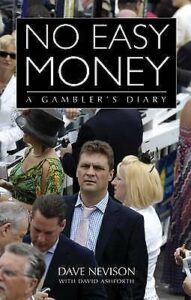 I’ve always admired Dave Nevison.