

Who Is Tony Bloom?

It’s always interesting to hear peoples’ opinions.

A number of people, out of the blue, have said how not only do they admire Tony Bloom but he is their hero.

Much of his life is veiled in mystery. But much is there to be seen. But what are we to make of this self-made billionaire? You don’t make that kind of money without being an exceptional businessman. What’s more amazing is that he has made most of his money from gambling.

This was inspired by his grandad who enjoyed a bet on the greyhounds.

Tony Bloom’s gambling story dates back to 1985, as a fresh faced 15-year-old he visited his local betting shop in Brighton using a fake ID.

What sets Bloom apart from your average gambler is his love of mathematics. In fact, he gained a degree from Manchester University. It is a subject he used throughout his life in both business and gambling.

In the early years of his career, he started work with Ernst and Young as an accountant. This along side his gambling saw him build a bankroll of 20K.

For a short while [6 months] he worked as an options trader but hated trading his time for money. From that moment, he decided to become a professional gambler.

In fact, winning money from Victor Chandler (Bet Victor) got him a job he couldn’t refuse as head of setup for Asian operations. This position would give him valued skills in his gambling career but for the moment he was working for a bookmaker and learning Asian handicapping and living a jet-set lifestyle.

Bloom, as known as The Lizard, was very knowledgable about football and especially informing Victor Chandler about the 1998 World Cup. It is said that Chandler won a significant amount of money over this period.

France beating Brazil 3-0 was a big money spinner for the firm.

It also showed the world that Bloom had talents for understanding football.

Bloom’s understanding of Asian handicapping inspired his entrepreneurial spirit, starting up a business called Premier Bet, the first on the market to use the Asian Handicapping System. He went on to sell this business. With the rise in internet gambling websites and platforms, he invested heavily. This was much to do with the success of American poker player Chris Moneymaker who won the 2003 World Series of Poker who become a world champion after qualifying via an online poker website.

Investing his profits, Bloom setup two poker sites: St Minver and Tribeca Tables.

This venture was influenced by Tony Bloom’s love of poker. He said: ‘Poker gives you a good grounding in lots of things, including reading situations and reading people and making tough decisions. Those skills can be used in business and in running a football club.’

Born in Brighton, in 1970, he never forgot his roots.

In fact, many fans of Bloom would have first heard of him when becoming chairman of Brighton Football Club in 2009 although he was associated with this south coast outfit many years before (2000). Originally investing £93 million, his fortunes allowed him to add over £400 million of his own money to secure the future of this nomadic club which was on the brink of collapse.

‘But what about Starlizard?’ I hear you say.

This betting consultancy is very much a secret in the amount of money it makes but profits are substantial. It has been claimed as much as £100 million a year. In fact, the two string service is prohibitively expensive with £14 million made in annual subscriptions alone. Total annual wagers on Asian Markets (mainly football bets) total over £3 billion.

His success is coined in this simple maxim: ‘We answer the most interesting questions in sport.’

‘We take analysis of sport into a completely different league. Through a combination of innovation and critical thought, we make the best sporting predictions in the world.’

For all of his wealth, Bloom remains a very likeable man although he respects his privacy. He is married with a son.

Alongside his business and gambling interests, he has a passion for horse racing. He found success with Penhill, trained by Willie Mullins, who who is a dual Cheltenham winner before retiring in 2020.

Tony Bloom is one of few professional gamblers and business men to become a billionaire and respected within the industry.
How do I find Value in a Small Field?

When gambling, it is important to have a little bit of introspection. Consider how you work because this is founded by how you think. It is all too easy to do something without giving it due consideration. I’ve found that punters all too often follow scripts. It’s literally like a script is playing in their mind and they just follow it like an actor saying their lines. This is all good and well if the script, actions, betting is productive and returns a profit. However, if your name is Jack Torrance, staring out the window of the Overlook Hotel, and your notepad says: ‘All work and no play makes Jack a dull boy!’ you may need to stop for a moment and reflect.
Now, I don’t know of too many punters who have put an axe through a door (although plenty may have felt like it) but be advised to stop and reflect on your thoughts with reflexivity and ask: ‘What’s going on here?’

Because, my friend, it may be something you don’t want or expect.

One of the best ways of doing this is to keep a journal and simply put pen to paper your thoughts, processes and conclusions. This is actually much more difficult than it seems but becomes easier with practice. The act of writing down your thoughts is proven to be much more powerful than thinking alone.

I have noticed how many times punters follow that same well-trodden path.

You follow that horse off a cliff! You follow that trainer who hasn’t had a winner in a month of Sundays!

You even woke up to find you had an axe in your hand!

It’s part of the human condition. The brain works in mysterious ways in an effort to make our lives simple. At times this literally leads you down the garden path wearing your comfy slippers and a hair shirt.

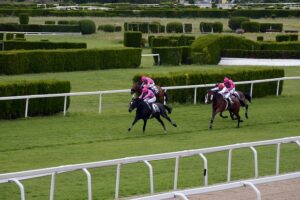
I’ve had this blind spot with horse races featuring a small field of let’s say 5 or less runners. This is in the two-year-old niche, as I know little about anything else. Often I would see the favourite priced at prohibitive odds. For example it is 1/4f. Now, there is a tendency to start following that destructive script, deep in your grey matter. I can tell you what it is saying: ‘The favourite is going to win so don’t bother thinking about this race and move swiftly on.’

Stop for a moment and write in your journal: ‘F*** the script!’

Because this is a problem and until you have to change it.

You don’t need it.

Here’s my reasoning. If you don’t bet odds on (I don’t) you will never bet on the jolly (favourite) in a million years. So all that horse can do is prevent you from betting. It’s like a big, old, bastard of a brick wall. It’s all pointless. It is a negative because it can only lead to another negative. When gambling, you have the opportunity to bet in the positive which gives you opportunities. You can structure your approach to work in the positive and that is a foundational skill to your thinking.

If you don’t bet in a race because you are scared of the odds on favourite that race is null and void.

However, think for a moment. Have you even looked at the race? You didn’t because you jumped to the conclusion the favourite had already won the race. Well, Jack Torrance, the race hasn’t even started yet!

You remember the positive script: ‘There’s no such thing as a certainty?’

Look at the three horses in opposition to the favourite. What do you think? There’s a 100/1 outsider who realistically is no opposition. The second favourite is unraced and given a fighting chance based on morning gallops and hyperbole. The third favourite has one race under its belt and presently priced 15/1 on Betfair.

There is a chance to nothing going on here.

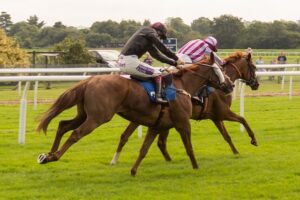
Why? Because the chances are the second favourite (unraced) will not live up to expectation. It is much more difficult for a debutante to win than the betting always suggests. It’s a statistical fact. The outsider has no hope. Within moments, you realise there is a very good chance this is a two-horse race. The odds on shot is priced 1/3. The horse you have your eye on is 14/1. Now no one is saying that every odds on favourite is going to lose. If you think I’m saying that you are following a negative script.

Remember if you don’t bet on odds on shots but fear the horse is the winner you stopped looking, thinking and considering. You gave the race the briefest glance. That’s your script at work.

By betting on the value in a small field you have a number of options to make money when betting on the exchanges:

  • The horse may be substantially backed giving an easy no-lose bet.

  • The betting in-running is very volatile and there is a very good chance your horse will touch must shorter odds.

  • Unlike the favourite which needs a 75% (if 1/3f) your horses needs to win once in fourteen times to break even.

By all accounts, the majority of times, it is simply a two-horse race. You have many and varied opportunities to make money here.

Each race needs to be viewed on its merits. Sometimes you win, sometimes you lose. It’s the nature of the beast.

However, stop for a moment and think about those scripts running through your mind. An equal measure of help and hindrance. You have the opportunity to pick between the two. The choice is yours.

The moral of this article isn’t about betting on a 14/1 winner.

It about the next time you look at the race card and you quickly skip the small race with the 1/4f that you have just fallen into a hole that only a psychologist could have dug. He’s peering down at you and saying: ‘It’s OK, Jack. Put the axe down and we can talk things through…’

Horse Racing: How To Find Value Bets?

Horse racing punters often talk about finding value. In essence, the odds you bet on a given horse are greater than its actual chance of winning. So you bet on Gee Up Neddy at 7/1 when its actual real chance of winning is 5/1. In truth, every winning horse is value. Every losing horse is poor value. That’s if you are betting a straight win. The theory is the same for all bets win, each-way, double, treble of Goliath. Those multi bets are often reserve of the ‘mug punters’ as the chance of winning a giant payout for a small bet is elusive and by all accounts a rarity.

Not to say that any bet can’t be a good bet.

As I often say, skill comes before money. If you know more than the layers you will make your betting pay. Patrick Veitch, a well-known professional gambler, estimated that he won over £7M over a seven-year period. You can read about his exploits in a very good book: Enemy Number One, published by the Racing Post.

Value is the key to successful gambling. However, there is an even more exciting concept called extreme value.

Extreme value can only be found by using data analysis and finding angles which few gamblers or layers appreciate. This advantage is understood by a limited number of professional gamblers who are literally cleaning up. The best angle for them is that even the bookmakers cannot anticipate their actions which leaves them vulnerable. For this reason, many are restricting winning punter’s accounts if not closing them down. However, these professionals don’t let that restrict them at all. The have found ways of betting which go beyond their detection or using the betting exchanges where their activity is part and parcel of the markets.

If you notice a horse has been substantially backed you can pretty much guarantee it is one of the limited number of professional gamblers who are using the technique known as extreme value.

This concept is in its infancy but it is making waves in betting markets covering all sports and if you are lucky you may even be given the opportunity to join forces with such teams. It is unlikely at this early stage but as the markets adjust to their activities they will look to subscribers to pay a bounty for such knowledge. Not that individuals will get their hands on the source data. Subscribers will put £5,000 into an account and they will get a percentage of the profit. This works well for the founders as they are guaranteed a bigger profit without any loss.

If you hear about a horse being substantially backed then you can guarantee it is from the extreme value group.

Does Betfair Have a Lack of Liquidity?

Betfair was founded in the year 2000.

The turn of the millennium bought much excitement to a gambling world that had seen change over the previous decades but slowly stagnating. The idea of a betting exchange was a revolution and it was an exciting time for backers and layer alike. For the first time the general public could become bookmakers without a licence.

It was truly a remarkable time.

Since those early days we have seen a number of betting exchanges such as Matchbook, Betdaq, Smarkets, Betconnect and Spreadex. We shouldn’t be scared of competition and it is good to have options. However, there is only so much money in the betting pool and with a vast number of bookmakers and betting exchanges there is cause to be concerned by the money being spread too thinly which doesn’t really help anyone. I don’t have the data to detail the liquidity of the Betfair markets some 15 years ago but they must have been a lot stronger than seem these days.

I follow two-year-horse racing and the limited money on the Betfair markets is concerning. When you see just £20,000 bet on a race (£10,000 in real money terms as the back and lay are shown) with perhaps 30 minutes before the off it is getting to the point where the markets are on the verge of collapse. When you consider that much of this is the same money going around with backs and lays with traders looking for a quick profit the actual real money bet on any given race must be miniscule. It’s true, the markets liven up in the last 10 minutes before the start of the race as the traders come in with bigger cash and the traditional gamblers look for value.

To be honest, the early markets, especially the evening before are almost worthless. You may get lucky and get a few quid on a horse but it really is a dance between the traditional bookmakers and the betting exchanges which makes markets volatile. I guess for the traders this isn’t all bad news. Certainly with poor liquidity there is ample opportunity for the markets to be manipulated with a small amount of money. I am sure some manipulate the exchange markets hoping the bookmakers push out the betting and someone steps in to take advantage. The bookmakers are then quick to readjust the betting and go much shorter odds which I’m sure they take advantage of too. Often these ‘gambles’ drift back out to similar or larger odds.

The only time you can guarantee good liquidity is on the major meeting especially the likes of the Cheltenham Festival when the betting is robust.

There is little we can do about poor liquidity. Perhaps if one or two of the platform disappear it will bolster the market strength but that’s unlikely to happen.

Personally, the exchanges are just about strong enough to cater for my needs because I’m betting smaller money or wait until just before the start of the race. However, if I wanted to bet £1000 it would be a pointless exercise. Sure, I could lay a bet of £1000 if I thought I could get a horse beaten but that doesn’t seem to happen on the early market where most backers and layers keep their cards close to their chest.

The betting exchanges are functioning. It’s as though they are ticking over and punters just wait for the late market to do business. Perhaps this is just the nature of the beast and a similar pattern on the stronger market too.

However, many punters are concerned that the liquidity is so poor that they would rather bet with bookmakers. However, with their restrictive nature of limiting or closing any account that may threaten their profit line you will be struggling to make much ground. I have heard of many punters opening up multiple accounts under different people’s names and betting small money across the board to slip under the radar. It really does seem a testing time for the gambling industry with welfare issues at hand which just makes a difficult situation worse.

It seems you are damned if you win or lose.

However, the betting exchanges are a lifeblood for many punters and I’m thankful they exist as bookmakers would sound a death knell to most profitable punters as they are restricted.

It’s a strange situation when bookmakers have turned into extremely ugly accountants.

They’ve taken the turf out of the equation which long term sees everyone lose.

For the time being, my first and last port of call will be the betting exchanges. At least if you get a bet placed you don’t have to fear the worst that your account won’t exist tomorrow.