Is betting on the Favourite for Losers?

So you fancy a bet.

As long as you bet responsibly then a little flutter isn’t going to do you much harm. In fact, you may pick a winner. For most punters betting with any aspect of skill is unlikely. Why? Because unless you work tirelessly at your craft you are unlikely to win anything. I don’t advise betting for fun. There’s nothing fun about losing money. If that’s acceptable, then you should question what you are doing.

If betting, you may want to appreciate a few pointers which I have considered long and hard.

Why Betting On The Favourite is a bad idea

Unsurprisingly, the majority of the money bet on a horse race is on the favourite. In fact, on an odds-on shot, it is probably 80% of all the money bet. But with the favourite being such a popular choice is it really worth a bet? The answer is probably no. To be fair, each and every horse can only be judged on its merits. I would be wrong to say that a decent percentages of favourite don’t win and, by their very nature, a winner is value. However, if you bet on every favourite you would lose money. This points to the fact that the only way you can win at betting is related to skill. It isn’t so much about money but your knowledge. This is the foundation to your success. Betting on a favourite in a horse race denotes the strike rate you need to break even or be in profit. Betting even money requires a 50% win rate to break even. From my vast data research and analysis, very few horses, trainers, jockeys or owners detail such a high strike rate.

Why You Need More Value Bets

Betting on favourites can be a distraction to betting on a big priced winner. For that reason, I don’t bet on any horses less than 7/1. You may be reading this and thinking how is this possible. I tell people and they look surprised. I can tell in that moment they are favourite backers. Nothing wrong with that. If you are in profit, you don’t need to listen to my words. If you are losing money you do. Now, this article isn’t going to tell you all you need to know how to win money gambling. You would need to start from a blank slate, learn lots over years and be as disciplined as it takes. There are no short cuts to success. But what I would say is draw the line closer to the bigger odds horses. The more you understand, the more you realise you don’t need to be betting at short odds. In fact, I rarely bet on horses that are not double-figure odds. If that sounds incredible then it is simply do to your lack of skills and understanding of seeing the full, bigger, picture.

How Do You See The Bigger Picture?

You see the bigger picture by looking at the smaller picture. No one can know everything. Wisdom states you don’t need to know everything. You need to know a little more than most. Know your niche. If you are a gambler and you bet on many different sports then you are spreading yourself too thin. In fact, you could do half the work and increased your profit substantially by simply betting more money. If you measure your success by financial return. You may follow horse racing for fun and bet matchsticks. Knowing less better is the answer to the question.

Answers to Questions

Being successful at anything is about knowing answers to questions. If you don’t know the answer to a,b,c then you need to ask yourself why. Why is the motivation of behaviour. If you can’t be bothered to understand your subject matter, hone your skills and learn what it takes to make your betting pay, then either carry on losing or stop betting.

Whatever you do, unless you know better, don’t bet on the favourite.

It’s a good place to start.

Is there really a beat called a ‘Bookies’ Nightmare’?

The short answer is yes, there is. Nowadays, most bookmakers settle bets using automated computer systems, which provide faster, more accurate results than traditional human settlers, so the bet is less ‘nightmarish’ than was once the case, but it is still trying enough, not least because of the number of disparate bets involved. Generally speaking, the Bookies’ Nightmare is not an option you’ll see listed with online bookmakers, so you may find it’s a rigamarole to place, never mind settle!

The Bookies’ Nightmare consists of 47 individual bets, staked on nine, unrelated selections, which are arranged into two Patents, two Yankees, one Round Robin and one, rather speculative, nine-fold accumulator. A Patent, of course, consists of three singles, three doubles and a treble, making seven bets in all, while a Yankee consists of six doubles, four trebles and a four-fold accumulator, making 11 bets. Thus, staking two Patents, on selections 1, 2 and 3 and selections 7, 8 and 9, respectively, plus two Yankees, on selections 1, 2, 3 and 4 and selections 5, 6, 7 and 8, respectively, constitutes 7 + 7 + 11 + 11 = 36 bets.

The remaining 11 constituent bets comprise a Round Robin on selections 4, 5 and 6 and a nine-fold accumulator on selections 1-9. The latter is self-explanatory but, for readers unfamiliar with the structure of the bet, the Round Robin is similar to a Patent, insofar as it includes three doubles and a treble on three selections, but also three pairs of single stakes about bets, a.k.a. up-and-down bets or cross bets, making 10 bets in all. Essentially, any return on each single, up to the original unit stake, is used to fund a further single on the other selection in the pair; clearly, the further single is conditional on a return from the first one.

What are some Professional Gambler Books You Will Love (& Hate)?

Who doesn’t love a good read?

Any would-be professional gambler may be spoilt for choice but which books are on readers hot lists and which are pure garbage?

Take a look at these 3 reads from Amazon reviews both good and bad.

1) Dave Nevison: The Early Years of Being a Professional Gambler

Published in 2008 by Highdown.

Pages: 304

Review:

Good: ‘Dave comes across as a decent bloke and sharp as nails. I found the book an easy read and quite entertaining. Along with another reviewer though I would have to say given the number of races he has actually attended there surely could have been a lot more tales of what happened/funny stories and also from his time working in the city.

It won’t give you any betting tips/strategies but to be fair it doesn’t set out to. I really enjoyed it and would recommend it. Why only 4 stars? Because when I got to 75% through the book and thinking to myself I’m enjoying this, boom, up pops the index! 25% of the book is taken up with an index??? come on, no padding Dave!


Bad: Nevison clearly fancies himself as someone living it high on the hog and openly mocks the esteemed Alan Potts for having nothing to show but ‘beans on toast’ for his efforts. He juxtaposes this with his own ‘playboy lifestyle’ where he adds a couple of rashers of bacon and some scrambled egg and parlays it up into a microwave meal in a transport caff. Move over Hugh Heffner – Nevison’s in town!

Being a Walter Mitty character is all well and good until you overstep the mark and Nevison does this on page 223 where he openly blasphemes Richard Hills, criticising his ride on Amoras at Salisbury and claiming the great man has one of the smallest fan clubs in racing. Shocking pocket talk that will inevitably lead to a fatwa from the great jockey’s church. What happened to Amoras subsequently that season you ask? Did he go on to rack up a sequence without Richard Hills? Well yes he did, but sadly it was a sequence of nothing but duck eggs. In fact no performance in the horse’s entire 43 race career hinted that he had the ability to win that Salisbury race or suggest that he was anything but mug punter fodder at 4/1 off a mark of 76. But why blame yourself, eh Dave, when you can launch unprovoked attacks on Richard Hills?’


2) Harry Findlay: Gambling For Life – The Man Who Won & Spent Every Penny

Published: 2017 Trinity Mirror Sports Media

Pages: 352

Review:

Good: Harry Findlay can best be described as a Marmite man – you either love him or hate him!

I make no apologies for falling into the first category.

This book tells the story of a real ‘character’ and the roller coaster he’s been on punting oveŕ 40 odd years. Yes, he may come across as loud, brash and a big time Charlie BUT he is also a man of the people. Loyal, decent and true to friends and acquaintances.

He comes across as the type of bloke who’d be happy having a couple of pints with the lads in the local having a game of brag and winning £20 as he would sitting in the Royal box at Ascot winning £500k on a horse.

Top man Harry. Racing is a poorer sport without you (and that’s all down to the BHA)


Great read if you love your gambling/sport.


Bad: I have read 296 pages of this book (it has 368) but no more. As a gambler for 50 years I thought this would be a good read but I found it dull and boring and must disagree with many of the reviews. I had an account closed for having 4 winning bets in a row and would like to know how Findlay managed to get large bets on so easily. The books jumps around with one minute he has won a fortune and 5 minutes later he is broke. Nobody seems to have a bad word for him although he has one or two for others. The last chapter highlights sports people who have enriched his life. Frankly I could not care less what he thinks.

3) Enemy Number One: The Secrets Of The Most Feared Professional Punter

Published: 2010 Racing Post

Pages: 304

Good: The ‘Secrets’ are the same ‘secrets’ that are behind anyone who excels in their chosen field: extreme focus, profound knowledge of the subject, total belief in your own ability and expertise, and plain hard work and determination! Mr Veitch’s approach is similar to that exemplified by the legendary American ‘gambler,’ Pittsburg Phil. He too used a network of agents to put on his bets, and had such a profound knowledge of his horses that he could ‘visualize’ how a race was going to be run. It’s easier now with videos available, but in order to have that absolute confidence in your selections, you need to have done the groundwork and investigated how races are run, how horses are trained, and how they are placed – and why they lose! Mr Veitch describes how he devoted hours studying the form book – and ruefully acknowledges that now – with so many data bases available – that work can be done in a fraction of the time. But it still needs to be done. Basically, anyone can accumulate the required knowledge – how you use it is paramount.

Mr Veitch’s approach also reminds me of the one outlined in Stewart Simpsons’ book ‘Always Back Winners,’ in that one notes horses which indicate they have greater ability than the bare form suggests.

If you take his many examples and access the data available at the Racing Post website, you can follow some of Mr Veitch’s thinking and planning. He is undoubtedly a very astute and intelligent ‘gambler,’ but he has the characteristics that would have made him a success in whatever field he chose. For anyone who has a serious interest in backing horses, this book is a rattling good read – entertaining and informative. The only thing is – he reminds me of Jerry Seinfeld!

Bad: This over-hyped account desperately needs to be sent to the knacker’s yard. It is written in such a turgid, matter-of-fact style – to be blunt, boring style – that I fear not even a set of blinkers would help. It cannot appeal to anyone without a thorough grasp of, and interest in, gambling and its only hope is to be entered in a seller at Plumpton. One to avoid at all costs.

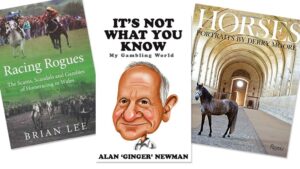
Do You Know Brian Lee?

That’s what my brother asked.

I find it disheartening that I’ve never heard about Brian, given his extensive 50-year career as a horse racing journalist—especially considering my own passion for horse racing spanning over 30 years. With a focus on two-year-old horse racing and a fondness for Chepstow Racecourse, he likely shared valuable insights on numerous talented juveniles.

Recently, my brother shared a link to an article about Brian published on the Chepstow Racecourse website by Graham Thomas. In this piece, the proud Welshman delved into his deep interest in horse racing and reflected on his career in racing journalism. Brian’s contributions extended to various Pembrokeshire newspapers, including the now-defunct Barry Gem.

The 86-year-old continued (and continues) his writing journey with a column in the Western Mail, covering horse racing for an impressive fifty years. Despite the challenges faced by the newspaper industry, leading to the discontinuation of his column, Brian remains dedicated to his love of writing. Far from retired, this highly respected horse racing writer and author of numerous books on the sport is a familiar face at Chepstow Racecourse. In 2020, he received the prestigious Lifetime Achievement honor at the ROA Welsh Horse Racing Awards.

Brian fondly recounted his initiation into horse racing at the 1949 Welsh Grand National, with his true passion ignited at a transformative point-to-point meeting at Rhiwbina Farm. His journey in racing journalism began at the age of 15 when he voiced concerns to Horse and Hound magazine about the lack of local sports coverage—resulting in a job offer.

From contributing to The Sporting Life to writing under ghost names for publications like the South Wales Argus and The Hereford Times, Brian’s influence on racing journalism is vast. His collection of scrapbooks, cuttings, and notes spans generations of horses, trainers, and jockeys, many of whom started in point-to-point racing before transitioning to formal competitions.

Brian’s experiences include encounters with notable figures like trainers Evan Williams and Peter Bowen and Aintree Grand National-winning jockeys Hywel Davies and Carl Llewellyn. Recalling the vibrant atmosphere at Penllyn racecourse, he marvels at the bustling scene with 34 bookmakers— a stark contrast to today’s racing that often has just six.

Despite witnessing unforgettable moments like Prince Monolulu at Cheltenham, Brian’s heart still longs for a Welsh trainer to win the Welsh Grand National, a feat not achieved since 1905. Summing up his journey, he describes it as a “labour of love.”

In the realm of horse racing journalism, it’s truly a pleasure to read and write about a gentleman like Brian—a seasoned expert who, after fifty years, continues to exude passion and knowledge about the sport.