What’s a Cliff Horse?

For those who have little understanding of horse racing they may think a cliff horse is a horse that stands on the edge of a cliff.

In truth, these beasts are more likely to have you standing on the edge of a cliff contemplating jumping and finishing the whole sorry business. Obviously, if anyone feels they are struggling with thoughts of suicide or self harming, they should seek professional help.

In essence, a cliff horse is one that you just can’t stop betting. Unlike Pegasus, it doesn’t sprout wings and fly off into the sunset with you perched on its back. You drop like a stone.

If you bet on a horse every time it runs in an unrelenting fashion you need to think you are caught up in such a scenario. It happens when you fancy a horse to win a race, place a bet, and it loses. You say: ‘Next time that will be a winner.’ So you bet the next time, then the next, live in a world of hope and dismay, carry on betting, the same horse, until one day you realise the beast is never going to win.

Every punter has bet on such horses.

It’s a good reason to question why you continue to bet on the same horse. I would suggest, at a push, you bet on the same horse twice. It isn’t third time lucky. A bookmaker must have come up with that maxim realising it was a money spinner.

I’ve studied two-year-old horse racing racing to the extreme and I have an understanding of why the cliff horse exists and why it’s a killer. The research details these horses are the proverbial loser waiting to happen. This must have a psychological underpinning, a behaviour related to attachment theory.

My studies have revealed that if a two-year-old horse doesn’t win in its first three starts in maiden company (not nursery) they have a horrendous strike rate. In fact, the only real hope they have is if starting favourite and then they can struggle.

What is the best approach to not bet on cliff horses?

Question what you are doing. Without an answer to a question, you are unlikely to make the right decisions. You are floating in the air at the mercy of your emotions and knee jerk reactions. It is a poor way of working and it will plague you for as long as you put up with it.

Here’s the answer to the question: Bet on a horse twice then stop.

Never again.

What is the origin of the word ‘furlong’?

The history of the word ‘furlong’ dates back to the Early Middle Ages. In the predominant European agricultural system of the day, known as the open-field system, the Anglo-Saxon acre was defined as a strip of land 40 rods, or 660 feet, long and four rods, or 66 feet, wide. When the land was ploughed, each furrow ran the length of the strip, such that ‘furlang’, derived from the Old English ‘furh’, meaning ‘furrow’, and ‘lang’, meaning ‘long’, came to mean ‘length of a furrow’. In Middle English, ‘furlang’ became ‘furlong’ and, in the Late Middle Ages, the term was used to describe a standard unit of length measuring 660 feet or, in other words, 220 yards or one-eighth of a mile.
Indeed, in the United Kingdom, the furlong remained an official measurement until it was excluded from commercial use, along with many other imperial units, by the Weights and Measures Act 1985. Nowadays, the furlong is used almost exclusively to specify the distances of horse races, traditionally to the nearest half furlong, or to indicate, in in-running comments, how far from the winning post a specific event, or events, took place; a typical in-running comment might include something along the lines of ‘…ridden and good headway to chase clear leader over 3f out, closing 2f out, led over 1f out…’ and so on.

By the time organised horse racing began, under the auspices of King Charles II, a.k.a. ‘Old Rowley’, in the second half of the seventeenth century, the furlong was a long-established unit of distance which, along with miles and yards, was particularly applicable on the racecourse. Certainly, for shorter races, the furlong provides a clear, unambiguous method of specifying fractions of a mile and, although not strictly necessary in modern horse racing, the tradition continues.

Who is Dave Nevison?

I’ve always admired Dave Nevison.

In fact, he was one of the first modern-day professional gamblers I found interesting. That was much to do with his publications which told of incredible stories of gambling illustrated with wisdom, humour and living life on the edge.

Nevison, originally from Halifax, West Yorkshire, got the gambling bug from his grandfather.

If you haven’t read any of his books then you will be delighted at the stories told.

A Bloody Good Winner: Life as a Professional Gambler was published by Highdown in June 2008. It was written in association with award winning writer David Ashworth who helped crafted a touch of magic within these prose.

It tells the story of Nevison taking the plunge as a professional gambler in 1993. In fact, it was his wife who encouraged him to follow his dream after becoming disillusioned working in the City specialising in foreign exchange and futures trading. With a redundancy package and savings, he had a betting bank of £50,000 to take on the bookmakers. His journey of backing horses for a living was ultimately a roller-coaster ride full of highs and lows. This book is a delightful mix of gambling, humour and a frank account of a betting man who beat the bookies at their own game.

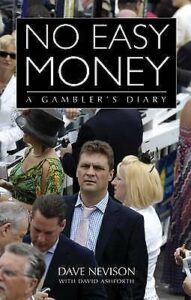
His second book No Easy Money: A Gambler’s Diary published later that year by the Racing Post (2008) detailed a contrasting story of gambling with a no holds barred account of his life on the road travelling to racecourses around the country. The story begins at the start of the 2008 Cheltenham Festival and concludes with the final Flat meeting of the year, the St Leger. His aim was to make 1 million. But did he win or lose? It’s a story of high emotion and ups and downs. A gritty read.

After almost two decades of professional gambling, Nevison started work with Racing TV in 2005 as a Horseracing Television Presenter, Pundit & Columnist. His expert knowledge, relaxed approach and humour, has made him one of the leading hosts on the show.

In recent years, he has suffered from ill health related to diabetes which has seen him wheelchair bound.

He continues his work and very much a punter’s pal.

Other gambling books worth a read include:

Alex Bird: The Life and Secrets of a Professional Punter (1986)

Be A Successful Punter: With Fineform as Your Guide (1988)

Bull: The Biography (1995)

Against The Crowd: The Methods of a Modern Backer (1995)

Enemy Number One: The Secret of the UK’s Most Feared Professional Punter (2010)

The Sure Thing: The Greatest Coup in Horse Racing History (2015)

Gambling for Life: Harry Findlay (2017)

Dave’s twitter account: https://twitter.com/nevisondave

Was Klute The Fastest Horse in the World?

You are probably saying: ‘That name sounds familiar.’

‘Klute.’

Wasn’t he a thoroughbred racehorse?

Even though Klute is a name many a sports fans will remember you may need to be a horse racing aficionado to put a name to a face. As the horse joke goes: ‘Why the long face?’

You will have to go back to 1988. The venue, Haydock Park, Liverpool, England.

The scene was set. Klute, owned and trained and ridden by Lesley Bruce. He wasn’t your average thoroughbred horse. He was raised as a pet. In fact, he never raced under official rules. He used to run for fun on the beach.

Klute was a horse that both captured the imagination but questioned data too. ‘How could he be the fastest horse in the world?’ The Guinness Book of Records detailed his achievement as fact. In a World Speed Challenge, Klute had seemingly achieved the impossible. He had run a remarkably fast half furlong at Haydock Park, recording a world record of 44.91mph. He beat the former record set in 1945 when Speedy Gonzales, a Mexican quarter horse, clocked 43.26mph.

While some rejoiced in Klute’s success others sneered at his ‘record’. They didn’t believe it was true.

‘How could he be the fastest horse in the world?’

Standing her ground, Lesley Bruce was confident Klute could face any competition. He wouldn’t be frightened to take on the best racehorse.

The challenge was set.

A challenger was found for Klute.

On the 12th August, 1988: 5:15 Haydock, Klute would face his sole challenger, So Careful, trained by Jack Berry.

The Philip Cornes Match (Speed World Challenge) over 5-furlongs.

Something didn’t seem right. The bookmakers chalked-up the prices. Surely, Klute would be odds-on to win this two-horse race?

So why was Klute priced 9/1 second favourite? So Careful, a horse with an official rating of 71, was priced 1/14.

Lesley Bruce would ride Klute. His opponent, So Careful, a five-year-old horse, would be ridden by professional jockey, John Carroll.

In a time of just 1m 4.34s the race was over.

Victory by 25-lengths, unchallenged. So Careful won without breaking into a sweat.

Klute’s reputation in tatters. A tearful Lesley Bruce, consoling her nine-year-old horse, questioning how he could have lost.

She said: ‘There was something wrong with him. He’s been ill.’

We will always wonder what happened to Klute’s exceptional pace. Was his World Record a fluke?

So Careful was a hard-as-nails horse that races 38 times, winning 6 times, but was far from an exceptional horse. If anything he was just an average horse.

It wasn’t the end of the story. Klute would have a second chance to prove that performance all wrong.

In 1990 Klute would face another rival from the Jack Berry stable, in Valldemosa. The venue Catterick Bridge, racing over a distance of 5-furlongs.

This time the bookmakers had given up any hope of Klute beating his sole opponent. Valldemos was priced at 1/33. There was little support for Klute at odds of 16/1.

The race comments detailed: Valldemosa: ‘Made all, easily.’ Klute was beaten by 8-lengths.

Klute’s title as the World’s Fastest Horse still stands today.