Is it possible to have a cheap day at the Races?

The cost of living crisis is enough to knock the stuffing out of having a day at the races.

Nothing’s cheap, hey. But it’s good to get to the races once in a while else you can go stir crazy.

But here’s a question: ‘How do you have a decent day at the races on the cheap and stay the night in a swanky hotel while enjoying a James Bond experience playing roulette for free?’

Is it Mission Impossible?

As regulars to Great Yarmouth horse racing I was disappointed to see the premier ticket for the Eastern Festival in September cost £32. I hate to complain but it’s a scandalous price for entry to a pretty average course. I love the track but I never thought I’d see the day when it was cranked up to that level.

However, our group of friends enjoy going to Great Yarmouth as it’s a bit of a gambling haunt and being on the Norfolk coast there’s plenty of entertainment.

Here’s my ‘cheap as chips’ way to enjoying a day at the races. This relates to my brother and I heading from March, in Cambridgeshire to Great Yarmouth.

Using a two to together rail card we get an open return for £39. It’s a decent journey which takes just over a couple of hours, changing at Ely and Norwich. From there, we head to the Feathers Public House located at Market Gates. It’s a friendly place and cheap beer. It’s a better option than drinking at the track as it costs about £7 a pint. I think a pint in the Feathers costs under £3.

Alternatively, you can go to Wetherspoon’s Troll Cart.

After a little libation, we get a taxi (usually Albies) to the track for a couple of quid each (definitely as cheap as a bus if three or four) and head to the Grandstand entrance. That costs £18 when booked in advance (£3 per booking fee). You get a race card and keep your badge as it’s worth a free pint later in the evening.

After a day at the races (betting or not) have a walk around the corner to the Avenue Pub for a quick pint and get a bus or taxi to the Carlton Hotel, Marine Parade. This hotel, especially out of season is exceptional value. A twin room with a sea view, and breakfast included, costs an incredible £44. The Carlton has a bar, entertainment, a clunky old lift but clean and tidy rooms, although, generally, dirty windows with all those seagulls.

Just one hundred metres down the road, you will find the Grosvenor Casino. It’s a great place to go for a cheap meal (they want to get you in the door to lose all your money). This listed building is like the setting of Casino Royale. Remember that racecourse badge? Take it to the cash desk in the gaming room and they will give you a voucher for a free alcoholic drink and free bet on the roulette to win a tenner. As one of the bookies on course use to shout at holidaymakers: ‘Money without work!’

That’s how to have a cheap day at the races and enjoy a night at the casino with a meal and breakfast before a return home.

At most it should cost you £80 per person.

Cheap as chips.

Are Horse Racing Syndicates A Good Idea?

Many horse racing enthusiasts have a drempt of becoming an owner of a thoroughbred. In mind, your horse would be a winner, perhaps the best horse ever to have raced. That’s what dreams are made of.
Personally, I have had similar thoughts.

However, owning a horse is very expensive. Buying a thoroughbred can cost from £1000 to several million. But what about the horse trainer fees and costs of looking after your horse. It is more expensive than you may imagine. In fact, it is probably £25,000 per year. So to purchase of a relatively cheap horse (£5000) and training fees could well cost £30,000.

This wouldn’t be such a bad idea if the UK prize money was better. Compared with many countries (France, USA, Hong Kong, Dubai) UK prize money is poor. An average race is worth about £5,000. And the stable take a percentage and does the jockey so a winning effort amounts to a minimal return. It is a sobering thought to realise that most horses don’t win. Very few horse win enough prize money to cover their costs. That is why racehorse ownership is best viewed as an expensive hobby.

For that reason, horse racing syndicates have become popular. It is a way of negating high costs making ownership more affordable. Syndicates may range from four or five to vast numbers of members. Also, the cost of each syndication can vary from a few hundred per year to tens of thousands if not substantially more.

The good side of being part of a syndicate is that it is more affordable. The negative is that you will potentially win less money and have less access to trainers and often little to no opportunity to visit stables, watch horses on the gallops and have that one-to-one relationship with the trainer or make plans for the season ahead. Most syndicates will have a racing manager who looks after all those things. You may well get a horse owners badge which allows you access to restricted parts of the racecourse including the paddock. You may well be rubbing shoulders with the great and good of racing.

I have been part of a horse racing syndicate with Newmarket trainer Julia Feilden. Their syndicate is called Newmarket Equine Tours. It was very affordable and great experience, to enjoy a day at the races with lovely people. It costs just £200 per year. You don’t receive any prize money if your horse wins. However, the syndicate has four horses which entitles you to go racing on a regular basis for free (with your owners and trainers badge). If you have plenty of time on your hands, love going to the races, meeting like-minded people, it is as cheap as chips.

In truth, syndicates are the lifeblood of the horse racing world. There are many well-known names including Middleham Park Racing, Inittowinit, Opulence Thoroughbreds to mention just a few. There are hundreds to choose from, many run by horse trainers themselves.

If you are very rich then owning a race horse (or horses) is a luxury you may be able to afford. However, for many a syndicate gives you a real opportunity to enjoy horse racing as an owner for a fraction of the cost.

Was Nick Mordin a Professional Gambler?

The quick answer is yes.

Mordin has always been well regarded for his analytical approach to horse racing and ultimately making his betting pay. This once advertising copy writer followed his passion into horse racing journalism which saw him write for Odds On magazine and Sporting Life’s Weekender. In 1992 he wrote his best selling book: Betting For A Living, published by Aesculus Press Limited. Mordin had so much faith in his book that he used it to make £1000 a month betting at weekends and public holidays.

Being in the public eye didn’t always sit well with Mordin, especially the negative aspects, and the opportunity to enjoyed his anonymity led him to becoming a professional gambler for the 1993/94 season. He decided to bet on the horses rather than write about them. That winter season, following National Hunt racing, he won about £3,000 a month.

However, the enjoyments of gambling for a living wasn’t all he expected with endless travelling up and down the motorway, going to three or four race meeting a week. Also, he found that everyone at the course from bookmakers, trainers to other professional gamblers were so focused on their work that there was no time for idle chitchat.

Being a professional gambler became a chore.

If professional gambling did anything for him, it reignited his passion for writing and it led to his next publication The Winning Look, published in 1994 by Aesculus Press Limited. In fact, this book was very much part of his gambling success. This publication detailed how intelligently observing horses in the paddock can help find winners and stay away from potential losers. Mordin’s book was another step forward for punters being informed. The insight gained from learning these vital skills from Betting For A Living and The Winning Look could put your average punter ahead of the game and be part of that elite 5% who had the skill and knowledge to pick a winning horse while attending the races.

Mordin went on to write two more publications:

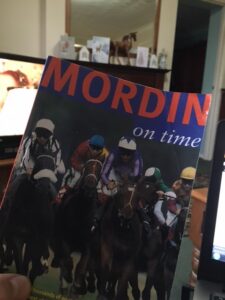
Mordin On Time, published by Rowton Press in 1996. Where he went about finding the answer to a fundamental question: ‘Which horse is the fastest?’

Winning Without Thinking: A Guide to Horse Racing Betting Systems, published by Aesculus Press Limited 2002 was the next offering. This book used over 30,000 hours of research and endeavoured to uncover the rules that govern the betting market and racing results.

Nick Mordin is probably the most influential horse racing researcher and author of noted publications in the UK. Unlike many professional gambler books, which detail stories and talk about money over how to make money gambling, he has given punters true enlightenment and insight to make their betting pay.

In recent years, Mordin seems to have vanished off the radar. Perhaps his anonymity is more important than being in the public eye. Who knows, it could be the case he is back on course as a professional gambler. I have little doubt he has the knowledge and wisdom to make his betting pay.

A true academic of the horse racing world and sadly missed.

What are the Advantages Of Using Betting Exchanges?

The betting world was transformed with the innovation of Betfair betting exchange that was founded in 2000.

Personally, I say: ‘Thank the Lord for betting exchanges.’

Any gambler who is a winner knows traditional bookmakers are impossible to bet. In fact, you have more chance of your account being restricted or closed. I’m pretty sure most are restricted as they don’t want to be seen for closing account.

It just isn’t playing the game.

When you hear the words turf accountant you are best to consider the latter of the two words.

There aren’t enough negative words to detail my thoughts about bookmakers.

So, we are looking at betting exchanges.

I have to betting exchange accounts: Betfair & Betdaq.

I haven’t used Betdaq although I do have money in the account. So Betfair is my go-to exchange and it has been a blessing. Saying that, I have had the odd problem when updating my account and one time it vanishing off the face of the Earth. However, it popped back up when I sent proof of identity and all that stuff.

I guess that’s the world we live in.

In essence, the betting exchanges make the perfect market. They do a job which once was the haven of odds compilers.

But how do we bet use the betting exchanges to make money as a backer rather than a layer? Those horses at the top of the market are often similar to the bookmakers. There will be slight variations and any price difference will be picked off. However, it is a changing market so there will always be peaks and troughs. The best angle for backers on exchanges come from betting on outsiders. If you have a fancy that’s 33/1 with bookmakers it could well be double or treble the odds on the exchanges. It’s such a marked difference that it simple cannot be ignored. Also, it is worth remembering that there are many traders on the exchanges. They have many and varied ways of working. Often they back a horse being backed and lay and horse being laid. It makes sense as this technique almost guarantees a profit unless you are caught by the extremes. This can be good news for backers if they fancy an outsider as they can be pushed to the limit. Often this may indicate a horse with less chance of winning (as if someone knows it won’t be tasting victory) but it doesn’t mean these horses cannot win as they often do.

In my opinion, betting exchanges offer a much more value and less problems than traditional bookmakers who are simply not interested in giving punters a fair deal. If they have the slightest thought you can win money they will restrict or close your account. It becomes a problem you don’t need.