
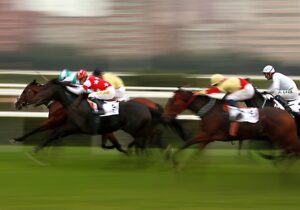
How has the form of the 2023 Derby worked out?

At the time of writing, the form of the Derby Stakes, run at Epsom Downs on June 3, 2023, is about to be imminently tested – as it has several times in recent weeks – when The Foxes, trained by Andrew Balding, attempts to justify favouritism in the Grade 1 Belmont Derby, over a mile and a quarter, at Belmont Park in Elmont, New York. The son of dual Guineas winner Churchill looked a non-stayer at Epsom, eventually finishing fifth, beaten 8¼ lengths, after weakening in the final half a furlong, so it will be interesting to see if dropping back in distance can see him return to winning ways.

Win or lose, though, the form of the Derby has, so far, worked out very well indeed. The half-length winner, Auguste Rodin, trained by Aidan O’Brien, has since followed up, albeit at long odds-on, in the Irish Derby at the Curragh a month later. In so doing, he once again took care of White Birch, Sprewell and his stable companion Adelaide River, who finished third, fourth and eighth at Epsom, although Adelaide River improved to finish a rallying second and was the only one to make a race of it with the winner.

Likewise, the Derby second, King Of Steel, franked the form with a comfortable, 3½-length win in the King Edward VII Stakes at Royal Ascot three weeks later. Once again he, too, took care of Derby also-rans Artistic Star, Dubai Mile and Arrest, who finished in the same order as they did at Epsom, but still six lengths, and further, behind the winner.

Finally, Waipiro, who could make no impression in the closing stages when a 10½-length sixth in the Epsom Classic, won the Hampton Court Stakes, over a mile and quarter, at Royal Ascot to give the Derby form an especially solid look. Unfortunately, with the exception of The Foxes, all the principals have now ‘played their cards’, so perhaps Military Order, who finished last at Epsom, but had previously beaten Waipiro in the Lingfield Derby Trial, could be the one to look out for on his return to a more conventional track.

What are Frankel’s Most Spectacular Wins?

Acknowledged as one of the greatest thoroughbreds to have raced. A sparkling trio: Frankel, wonder horse, Sir Henry Cecil, trainer, and Tom Queally, jockey.

Exceptions to the rule.

Frankel’s racing career started at Newmarket on the 13th August 2010 and ended with his retirement from Flat racing on the 20th October 2012. In total, he achieved stardom winning 14 races without defeat.

Personally, I never saw Frankel in the flesh, and it is one of my horse racing regrets. This son of Galileo, out of the mare Kind, won total prize money a fraction short of £3M.

A total of 14 successes. His best performance, a matter of opinion. However, I do have a personal favourite.

Can you guess which race?

The Quipco 2000 Guineas. Racing at Newmarket’s Rowley Mile. The 30th April 2011, a truly remarkable day for horse racing fans who questioned what they were seeing. A spectacular performance. It sounds ridiculous but nothing prepares you for a race like that. It sticks in the mind. It stays in the mind. A race to be treasured. It does to this day. What a race. Watch in wonder. Enjoy a spectacle that simply doesn’t happen.

It happened.

Frankel was priced ½ favourite to win a first prize of £198,695.

It really wasn’t about money. Frankel was fighting for his reputation as a wonder horse. You can’t imagine the pressure of those who planned his every move with precision. Sir Henry Cecil, who struggled with terminal illness, cancer. Queally questioned and knocked with every ride. Some willing him to lose. The pressure. Just think of the emotions they felt. Almost touching the clouds, fingertips stretching upwards. At that time, we didn’t know the future. We couldn’t bask in the sunshine or glory.

Not yet.

I remember that day, being excited. Five previous performances had gone to plan but there was a mix of excitement and fear. Today could lead to defeat. We could only take one race at a time. We didn’t know the future. No one did. Only time would tell its story.

So why did this race stand out from all the rest?

Frankel didn’t just lead but stormed clear with the cheers of a crowd. A chasing pack, like baying dogs, it was a surreal experience. In fact, by halfway Frankel looked to be leading by fifteen or more lengths. It seemed impossible. A Classic race. I thought I was watching a maiden race on a sunny day at Great Yarmouth. This wasn’t inferior opposition.

It was Frankel.

Simply wonderful.

This was a field of quality horses. The best of the best. Horses with big reputations. All trying to knock Frankel off his pedestal.

Had Tom Queally gone too fast?

As the race progressed the lead diminished but to no great extent.

Frankel crossed the line six lengths clear of the second, Dubawi Gold, trained by Richard Hannon. Third, Native Khan. These horses are detailed because they are important to this story.

The Racing Post comments said: ‘Soon led and clear, at least 10 lengths clear halfway, ridden just over 1f out, idling but kept on final furlong, ridden out, unchallenged, impressive.’

I have watched thousands of horse races but that race was different from all others. It was a mix of excitement, absurdity and reverence. It was a sight that only a superstar horse could produce.

It was an extraordinary performance.

Frankel.

Exceptional.

Perhaps it was a once in a lifetime event. Over 12 years have passed since that day and I am still waiting..

.

Something tells me I will be waiting for a very long time.

How can we compare professional gamblers?

Dave Nevison said: ‘He is a Bloody Good Winner.’

In fact, it is the title of his book about years of punting on the horses as a professional gambler. It’s a great read and full of the truths of gambling, humour and the trials and tribulations that working at the rock face reveals.

For many, the ambition of being a professional gambler is a real ambition. But, in truth, it is a difficult although exciting life to live. I’ve read many gambling books and comparing and contrasting their findings. It begs the question: ‘Are all professional horse racing gamblers the same?’

It seems logical to think they are the same. They have found the key to success. But is it the same key? And if we found that secret, would we beat the bookies at their own game?

I’ve read the following professional gambler books from these well known punters:

Dave Nevison

Phil Bull

Alec Bird

Patrick Veitch

Jack Ramsden

Harry Findlay

Barney Curley

To detail one pro gambler let’s consider Phil Bull’s 10 Commandments on successful gambling.

Here are his golden rules:

1. Only bet on selections you consider value-for-money (for Bull this could have even been odds-on shots)

2. Luck, the law of averages and staking plans are delusional, so place no faith in any of them.

3. Bet according to your means and adjust your stake according to the chance of your selection, as you see it; a selection with a greater chance deserves a higher stake.

4. Do not bet each-way in large fields, unless you are satisfied that the place portion of the bet represents value-for-money.

5. Shop around with bookmakers and the Tote to find the best prices, according to your judgment.

6. Do not bet ante-post unless you know your selection is a definite runner.

7. Do not buy systems; if you come across a profitable system, keep it to yourself.

8. Bet in doubles and trebles if you want to, but not on objections.

9. Make wise, attentive betting decisions and adopt a patient, cautious approach to betting, but do not be afraid to be bold if circumstances dictate.

10. Bet only what you can afford to lose; increasing stakes beyond your means, even in the short-term, can lead to catastrophic losses.


Interesting points.

But are all pro gambler singing from the same hymn sheet or have the same gambling philosophy?

The quick answer is ‘No’.

In fact, the first thing you notice is that very few pro gamblers follow a similar approach. Obviously, there are a few foundational similarities but personally they are a contradictory group of people.

I’d love to gather a few of the biggest names in gambling and see where the conversation went and what was said. I’m pretty sure it wouldn’t take long before each looked at the other and muttering to themselves: ‘That bloke hasn’t got a clue what he’s talking about. How on earth did he make any money gambling?’

‘Loser!’

As a gambler myself, I have thought the same.

I think what we can take from such difference is that our nurturing as a gambler finds its own route via success or failure. In that sense, winners dictate your betting approach, process and method. It isn’t a bad thing. There is no proven route to gambling on the horses, your staking plan, bets and anything you can imagine.

Don’t limit others in the sense that they may have a very different approach to you. In reality you should only measure your success or failure compared with yourself. It is pointless comparing your self to others although it is human nature to do so but far from productive.

The thing about successful gambling is that all roads can lead to Rome. You don’t need to question others to the tenth degree. Someone is making their betting pay because they have taken the time to find answers to questions.

Winning at gambling is about finding answers to questions.

As Tony Bloom said: ‘We answer the most interesting questions in sport.’

And that is, basically, the answer to the question of being a successful gambler.

Knowledge.

How many times has Art Power won in Ireland?

For reader unfamiliar with the name, Art Power is a six-year-old gelding owned by King Power Racing and trained by Tim Easterby in Great Habton, North Yorkshire. A son of Dark Angel, a leading sire of sprinters, Art Power has been campaigned exclusively over five and six furlongs and, all told, has won eight of his 27 races since making his debut at Newcastle in September, 2019.

On British soil, Art Power has reserved his best form for Ascot, where he was an impressive winner of the Palace Of Holyroodhouse Handicap in June, 2020, and not beaten far in either the Group 1 British Champion Sprint Stakes the following October or the Group 1 Diamond Jubilee Stakes the following summer. However, while the popular grey has amassed around £470,000 in prize money in Britain, a little over half that amount has come from placed, rather than winning, efforts and he has yet to win a Listed or Pattern race.

On the opposite side of the Irish Sea, though, Art Power has proved nothing short of a revelation. He made his Irish debut, as a three-year-old, in the Group 3 Lacken Stakes, over six furlongs, at Naas in July, 2020, justifying odds-on favouritism by winning comfortably under hands and heels riding. Eight defeats later, including six at Group 1 level, Art Power returned to Ireland for the Group 3 Renaissance Stakes, again over six furlongs, at the Curragh in September, 2021; again he won easily, at odds-on. He won the same race, in similar fashion, in 2022 and in 2023, so far, has made two more successful visits to the Co. Kildare venue, winning the Group 2 Greenland Stakes,over six furlongs, and the Group 2 Sapphire Stakes, over five, by wide margins to take his record in the Emerald Isle to 5-5.

Reflecting on his most recent victory, winning jockey David Allan said of Art Power, ‘He just livens up coming here and down at the start I could feel him coming to life.’