

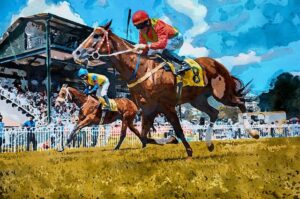
 On September 8, 2023, as reported in the ‘Racing Post’, Billy Loughnane rode Lambert, trained by George Boughey, to a comfortable victory in a novice stakes race at Kempton, taking his career total to 95 and thereby riding out his remaining 3lb claim. Loughnane, who only turned 17 on March 2, 2023, had his first ride in public on Starfighter, trained by his father, Mark, at Newcastle on October 24, 2022, and rode his first winner, Swiss Rowe, also trained by Loughnane Snr., at a fog-bound Wolverhampton on November 28, 2022.
‘Billy The Kid’ joined the senior ranks just over nine months later, a feat made all the remarkable for the fact that he spent a few weeks in the United States riding work for Anna Meah, whose husband David is a friend of his father, in February, 2023, and a few more on the sidelines, having suffered a fractured thumb in a stalls incident at Nottingham on July 21, 2023. Loughnane broke through, in dramatic fashion, in early 2023, riding 23 winners in January, 11 more in March, following his Stateside sabbatical, and being crowned champion all-weather apprentice, with a total of 41 winners, at the All-Weather Vase meeting at Lingfield Park, on April 7, 2023.
At the last count, the rising star of the weighing room had ridden a total of 89 winners in 2023, so far, 16 of which were saddled by his father. Since the start of the apprentice jockeys’ championship on May 6, 2023, he has, at the time of writing, ridden 44 winners, giving him a lead of 12 over his nearest rival, defending champion Benoit de la Sayette, with 40 days left until British Champions Day at Ascot on October 21, 2023.
 The late John Thomas ‘J.T.’ McNamara, who died at his home in County Limerick on July 26, 2016, at the age of 41, was one of the finest amateur jockeys in the history of National Hunt racing. On March 14, 2013, McNamara suffered a calamitous injury when his mount, Galaxy Rock, fell at the first fence in the Fulke Walwyn Kim Muir Challenge Cup at the Cheltenham Festival. He fractured the C3 and C4 vertebrae in his neck, which led to him being placed into a medically-induced coma and left him paralysed from the neck down. Three years later, he suffered complications arising from the injury, which ultimately led to his untimely death.
 The British Triple Crown has rarely been attempted during the five-and-a-bit decades since Nijinsky became the last horse to win the 2,000 Guineas, the Derby and the St. Leger, all under Lester Piggott, in 1970. However, it is worth remembering that the even Nijinsky, once described by his legendary jockey as ‘probably the most brilliant horse I’ve ever ridden’, was the first winner of the Triple Crown since Bahram, who was retired unbeaten after nine races, in 1935. In other words, notwithstanding the emphasis on speed, rather than stamina, in the modern bloodstock industry, not to mention the temptation of richer pickings in, say, the Prix de l’Arc de Triomphe – which is run over two and a half furlongs shorter than the St. Leger, but at the same time of year – winning the Triple Crown is, and always has been, an inordinately difficult feat.
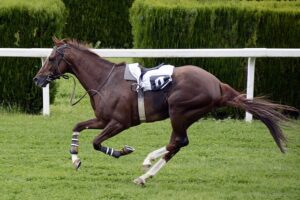 Run over six furlongs and open to horses aged three years and upwards, the Stewards’ Cup is the betting highlight of the fifth and final day of the Qatar Goodwood Festival, a.k.a. ‘Glorious Goodwood’, staged annually in late July or early August. With a maximum field of 28, the Stewards’ Cup is invariably a well-contested betting heat, as was the intention of Lord George Bentick – an influential figure who was, among other things, an inveterate gambler – when he conceived the race, in its current guise, in 1839. Indeed, the popularity of the Stewards’ Cup is such that, nowadays, a consolation race, the Stewards’ Sprint Handicap, is staged earlier on the card for horses balloted out of the main event.